| Chinese Ambassador to Belgium Fei Shengchao Gives Interview to The Brussels Times |
| 2025-07-22 22:00 |
|
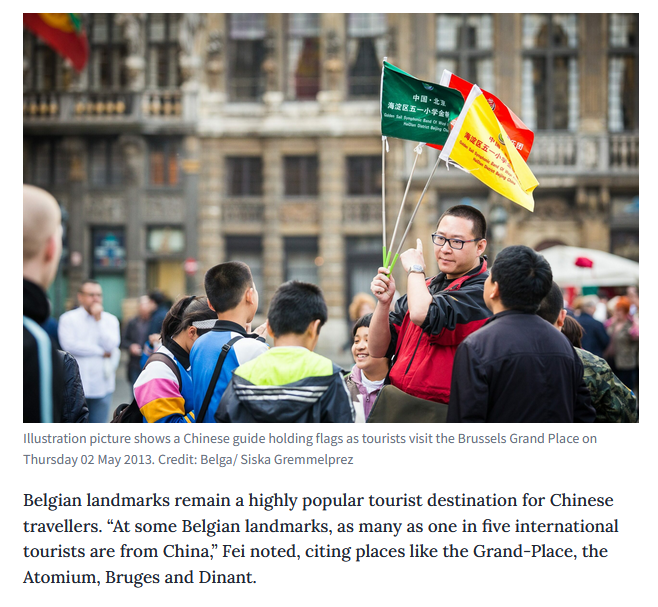
On July 20, 2025, the biggest English newspaper in Belgium The Brussels Times published the interview with Chinese Ambassador to Belgium Fei Shengchao. Ambassador Fei introduces China-Belgium relations, economic and trade cooperation, people-to-people and cultural exchanges and China’s principled positions on issues such as “overcapacity” and “industrial subsidies”. 1. How does China view Belgium? What common Belgian brands, traditions, customs or other symbols come to mind in your country? Chinese people regard Belgium as a beautiful and unique country located in the “heart of Europe.” Its free and open trade environment, vibrant and diverse culture, as well as its advanced industrial and technological sectors, are well recognized in China. In fact, the Port of Antwerp-Bruges, chemical and pharmaceutical industries, clean energy and diamond processing, have all become prominent symbols of Belgium in China. As a sports lover, when I think of Belgium, like many Chinese sports fans, the first thing that comes to mind is Team Belgium “Red Devils”, the famous footballer Kevin De Bruyne, and Jean-Michel Saive, a former world No.1 table tennis player from Belgium, both enjoying considerable popularity in China. For Chinese travelers, landmarks like the Atomium, the Grand-Place and the Manneken Pis in Brussels, the cities of Bruges and Dinant are all must-visit places. At some Belgian landmarks, as many as one in five international tourists are from China. Belgian delicacies such as chocolate, beer, fries and mussels have won the hearts and palates of many food lovers in China. At the same time, millions of Chinese art and music fans have fallen in love with the works of the surrealist master René Magritte, the captivating animated series The Adventures of Tintin, the classic Smurfs comics, and the graceful melodies of the saxophone. As cultural and people-to-people exchanges continue to flourish between China and Belgium, we believe that more and more Chinese people would love to further explore, appreciate and feel the unique charm of Belgium themselves.
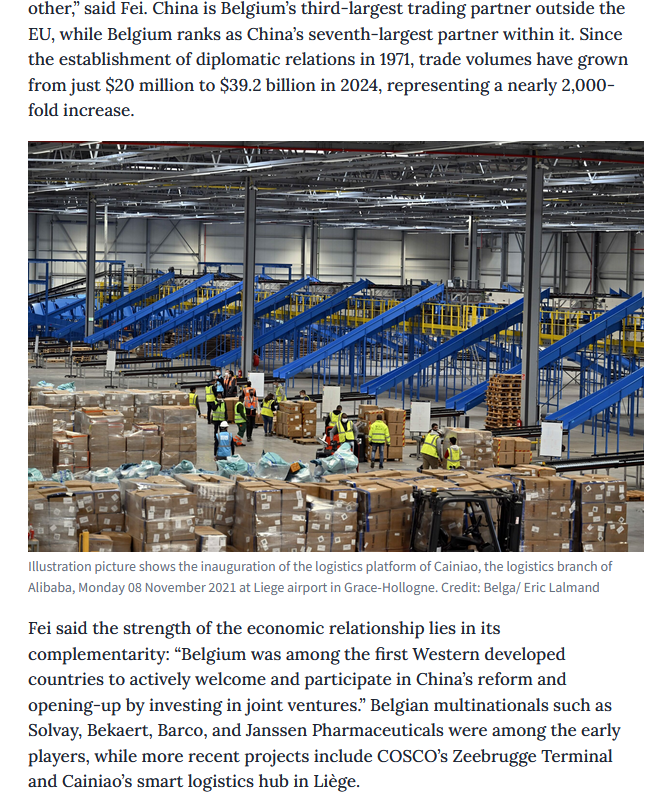
2. How have trade relations between our two countries grown over the last decade? Are relations moving in a positive direction? What possibilities are on the horizon? China and Belgium are important economic and trade partners to each other. China is Belgium’s third-largest trading partner outside of the EU, while Belgium ranks as China’s seventh-largest trading partner within the EU. When the two countries first established diplomatic relations, the bilateral trade registered approximately USD 20 million. By 2014, when the two countries upgraded bilateral relations to an all-round partnership of friendship and cooperation, this figure had surged to USD 27 billion, and by 2024, it further increased to USD 39.2 billion, nearly 2000 times the volume at the beginning of diplomatic ties. Complementary strengths and mutual benefits are defining features of the practical cooperation between China and Belgium. Belgium was among the first western developed countries to actively welcome and participate in China’s reform and opening-up by investing in joint-ventures in China. Well-known Belgian and international companies such as Solvay, Bekaert, Barco, Bell and Janssen Pharmaceuticals have contributed to the great success of China and themselves with enormous economic and social benefits. The Volvo plant in Ghent, COSCO’s Zeebrugge Terminal and the smart logistics hub of Cainiao Network in Liège have further strengthened China-Belgium cooperation while keeping and creating thousands of jobs for local communities and strengthening Belgium’s competitiveness in manufacturing and logistics. China and Belgium enjoy broad prospects for cooperation in areas such as agri-food and agriculture, pharmaceuticals, green development, and logistics and transportation by air, by sea, by road and by rail. Despite the bad weather in international trade, China-Belgium economic and trade ties have proven to be quite resilient and productive across a wide range of fields. Frankly speaking, there are indeed some challenges facing China-Belgium economic and trade cooperation. Some media have been hyping up China-related economic and trade topics such as “overcapacity” and “industrial subsidies.” Such narratives tend to oversimplify and attribute one party’s own economic difficulties solely to another party’s economic policies, while ignoring the nature of mutual benefit and the broader context of win-win cooperation between the two parties. Unlike some in other quarters, many in China and Europe still believe in the value of free and fair trade. Trade benefits families, businesses and nations alike, which is a blessing, not a burden. With a population of 1.4 billion, China is the world’s second-largest economy and consumer market, and has the biggest middle-income group of over 400 million people. Every year, China imports over USD 3.2 trillion worth of goods and services. China is now deepening reforms comprehensively and advancing Chinese modernization. Whether others would choose to close their doors, our doors to the world will only open wider. This will create enormous market opportunities for Belgian products and services, offer an open and productive platform for Belgian businesses to make good use of their unique and niche strengths, and provide ideal and abundant application scenarios for Belgian technologies to be translated into market returns and enhanced competitiveness. When clouds are gathering in the global economic landscape, the outlook for China-Belgium economic and trade cooperation is as bright as ever. Whatever the changes elsewhere, China and Belgium remain unchanged in promoting open, free and fair trade within the WTO framework and championing multilateralism in international relations. For China and Belgium, we both know business, we both mean business, and we are both open for business.
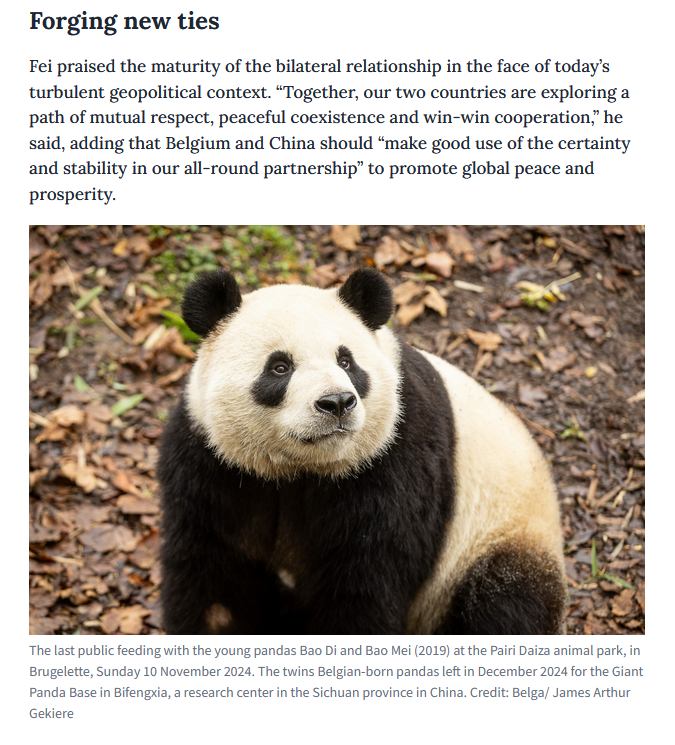
3. Can you speak of any events or celebrations which have helped bring our nations closer together? How have diplomatic efforts helped bring our two nations closer together? Diplomatic efforts, especially high-level exchanges, have played a vital role in advancing China-Belgium relations. October 25, 1971, marks the official establishment of diplomatic ties between the two countries. But as early as a decade before that, Queen Mother Elizabeth, despite her advanced age of 85 and numerous obstacles, made a historic “ice-breaking” visit to China. She was warmly received by Chairman Mao Zedong and Premier Zhou Enlai, joined the National Day celebrations on the Tiananmen Gate, and engaged widely with people from all walks of life in China. This visit became a treasured moment in the history of China-Belgium relations and laid important groundwork for the eventual establishment of diplomatic ties between the two countries. After returning to Belgium, the Queen Mother described her trip to China as the best she had ever had. In 2014, His Excellency Chinese President Xi Jinping paid a state visit to Belgium, during which the two countries established an all-round partnership of friendship and cooperation. The next year, His Majesty King Philippe of Belgium paid a return state visit to China, his first since ascending the throne. The two visits have brought China-Belgium relations to new highs and offered strategic guidance for the growth of our relations, delivering benefits to both peoples. Over the past half-century since the establishment of diplomatic ties, all-round cooperation and friendship have always been the main theme of our relations despite changes in the international landscape. When differences and frictions arise, they have more often than not been properly managed and addressed. Together, our two countries are exploring a path of mutual respect, peaceful coexistence and win-win cooperation despite our different political systems and historical backgrounds. This is attributable to the commitment and guidance of our leaders, who have charted the course for China-Belgium relations. It is attributable to our shared approach of seeking common ground while reserving differences and co-existing in harmony with mutual respect. It is also attributable to our commitment to mutual benefit and win-win cooperation, through which we contribute to each other’s success and to a brighter world together with an open mind and hand in hand. Today, the world has entered a new period of turbulence and transformation. With increasing international uncertainties and instability, China and Belgium need to make good use of the certainty and stability in our all-round partnership of friendship and cooperation to step up communication and cooperation, enhance mutual trust, and promote world peace, stability and prosperity together. 4. If you have any other anecdotes to share about the relations between our two countries? How does the embassy perceive its existence in the Belgian capital? Here I’d like to share two stories. The first is about China-Belgium cooperation on animal conservation. The giant panda is a friend of all humanity and has also become a symbol of the friendship between our two peoples. This special bond began in 2014, just before Chinese President Xi Jinping’s state visit to Belgium. In February of that year, two giant pandas Xing Hui and Hao Hao arrived at Pairi Daiza in Belgium. During its stay, Hao Hao gave birth to three panda cubs, Tian Bao, Bao Di and Bao Mei. They have attracted a huge fan base in Belgium and beyond. These adorable pandas brought our peoples closer and made important contribution to global efforts in panda conservation. As agreed by both sides, the three young pandas returned to China last December, but the friendship they have helped to build lives on in the hearts and minds of many in both countries. Golden snub-nosed monkey, a rare species native to China, is a symbol of peace, wisdom and vitality. In May this year, three golden monkeys made a long journey to Belgium. They open another window on China’s breathtaking nature and rich culture, further enhancing friendship and cooperation between our two peoples.
The second story is about an inspiring Belgian cyclist on a journey to China. In April this year, I had the pleasure of seeing Mr. Claude Brouir off at Cinquantenaire Park as he set out on his proud and extraordinary journey “Bike2Shanghai.” He plans to ride a solar-powered bicycle across the Eurasian continent, travel 12000 kilometers and arrive in Shanghai this August. He has already entered China and is right now riding in China’s Gansu Province on the ancient Silk Road that connects peoples and cultures. This journey crosses not only space and borders, but also time and civilizations. It’s a bridge-building ride, one that helps to lend fresh impetus to people-to-people and cultural exchanges between China and Belgium. Belgian nationals now enjoy 30-day visa-free entry into China and there are 17 direct flights a week between the two countries. Our Belgian friends are most welcome to visit China, explore its beautiful landscape, culture and customs, and see and experience a China very much different from what’s often portrayed in a distorted light by some media. The mission of the Embassy of China in Belgium can’t be more simple and clearer: that is to deepen China-Belgium relations and promote cooperation and exchanges across the sectors. We are here to foster all-round friendship and cooperation between the two peoples and to safeguard the legitimate rights and interests of Chinese institutions and citizens in Belgium. We are committed to opening more windows and doors for Belgian friends to gain a full, objective and accurate understanding of China and China-Belgium relations. And we will continue to build bridges and break barriers to strengthen communication and cooperation between our two countries and to deepen friendship between our two peoples. In a changing world today, that’s the best we can do and we should do to make our shared planet a better place for all, more peaceful and more prosperous. |
 | ||||||||||||
 | ||||||||||||
|